
Bitcoin remains the most traded digital asset in the world, but trading it consistently is a different challenge from simply holding it. Price swings that look manageable on a monthly chart can translate into significant intraday volatility that catches unprepared traders off guard.
The fundamentals of sound trading apply to Bitcoin as much as any other market. Entry criteria, risk management and emotional discipline matter more than any specific indicator or signal. Without those foundations in place, the volatility that creates opportunity also creates losses.
Traders looking for structured guidance across Bitcoin strategies, risk management and broader crypto market resources will find relevant coverage at crypto30x.com.
Table of Contents
What Makes Bitcoin Trading Different
Bitcoin trades around the clock across exchanges in every time zone. There is no closing bell, no circuit breaker and no regulatory pause when volatility spikes. A price move that would halt trading on a traditional exchange for the day continues uninterrupted in crypto markets, which means the risk of significant moves occurring while a trader is away from the screen is a permanent consideration rather than an edge case.
Liquidity is deeper in Bitcoin than in any other digital asset, which makes large position entries and exits more manageable than in smaller cap alternatives. That liquidity also attracts institutional participants whose order flow can move markets in ways that retail focused assets do not experience to the same degree.
Correlation with broader crypto market sentiment is another factor that distinguishes Bitcoin trading from traditional asset trading. When market wide sentiment shifts, Bitcoin often moves first and the rest of the market follows. Understanding this dynamic helps traders anticipate conditions rather than simply react to them.
Bitcoin Trading Strategies That Work
Different strategies suit different trading styles, schedules and risk tolerances. No single approach works for every trader, and the one that produces consistent results is almost always the one that fits naturally with how a person actually thinks and operates under pressure.
HODLing remains the most straightforward approach. Buying Bitcoin and holding through market cycles based on a long term thesis requires no technical analysis and no active management. The challenge is entirely psychological, maintaining conviction through drawdowns that can exceed sixty percent without a defined exit strategy.
Swing trading suits traders who want active exposure without the demands of day trading. Positions held for days to weeks target price moves that develop over that period, with entry and exit points defined by technical analysis rather than intraday fluctuations. Fewer transactions mean lower fees and less cognitive load compared to shorter term approaches.
Dollar cost averaging removes the pressure of timing entirely. Investing a fixed amount at regular intervals regardless of price means more Bitcoin is acquired when prices are low and less when prices are high. Over extended periods, this approach has historically produced better outcomes than attempting to identify optimal entry points.
Technical Analysis for Bitcoin Trading
Technical analysis provides a framework for making decisions based on price history and market structure rather than opinion or sentiment. It does not predict the future, but it creates a consistent basis for evaluating whether a trade setup meets defined criteria before a position is opened.
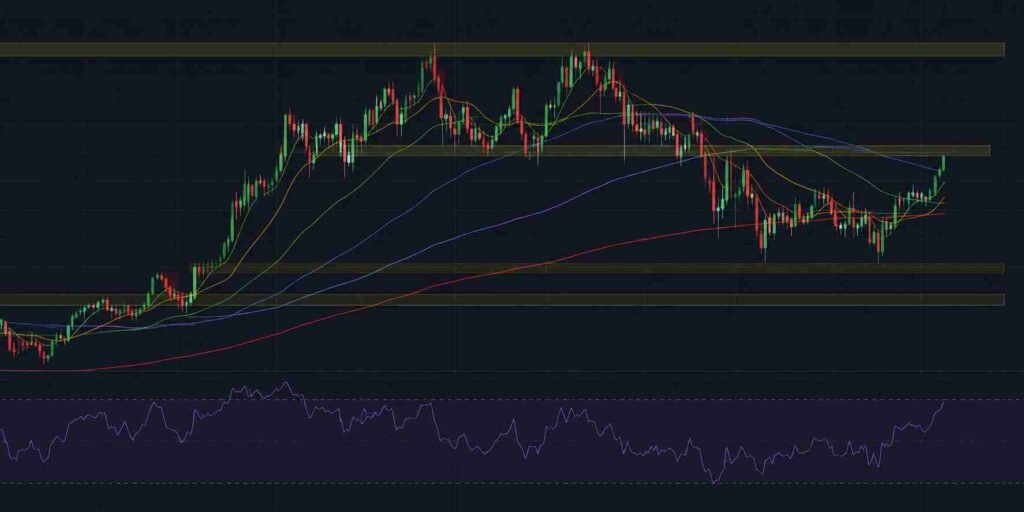
Support and resistance levels are the foundation of most technical approaches. Price tends to react at levels where it has previously reversed, and identifying these zones in advance gives traders reference points for entries, exits and stop loss placement that are grounded in market behavior rather than arbitrary decisions.
Moving averages smooth out short term price noise and help traders identify the direction of the prevailing trend. The 50 day and 200 day moving averages are widely watched in Bitcoin markets, and crossovers between them have historically signaled significant shifts in medium term momentum.
The Relative Strength Index measures the speed and magnitude of recent price changes to identify whether an asset is trading in overbought or oversold territory. In trending markets, RSI readings that would signal reversal in ranging conditions often persist for extended periods, which is why RSI works best as one input among several rather than a standalone signal.
Volume confirms or questions price moves. A breakout above a key resistance level accompanied by significantly higher than average volume carries more weight than the same move on thin volume. Divergences between price direction and volume trends often precede reversals worth paying attention to.
Risk Management in Bitcoin Trading
Position sizing is the most important risk management decision a Bitcoin trader makes. Allocating a fixed maximum percentage of total trading capital to any single trade limits the damage any one loss can cause regardless of how strong the setup appeared at entry. Most experienced traders keep individual position risk to a small percentage of total capital, ensuring that a losing streak does not significantly impair the overall account.
Stop loss orders define the maximum acceptable loss before a position is closed automatically. Placing a stop loss at a technically meaningful level, below a support zone rather than at an arbitrary percentage, gives the trade room to develop while limiting downside if the thesis proves incorrect.
Leverage amplifies both gains and losses. Bitcoin’s natural volatility already provides significant price movement without leverage. Adding leverage to that volatility creates a combination where even moderate adverse moves can result in substantial losses. For traders still developing their strategy, avoiding leverage entirely until consistent results have been achieved without it is the more rational starting point.
The crypto wallet guide covers how security and custody decisions connect to active trading, particularly for traders moving funds between exchanges and personal wallets as part of their regular workflow.
Common Bitcoin Trading Mistakes
Entering trades without a defined plan is where most early losses originate. A position opened because Bitcoin has moved sharply in the last hour or because a social media account with a large following posted a price target is not a trade. It is speculation with no defined exit, no stop loss and no basis for evaluating whether the decision was sound regardless of outcome.
Overleveraging is the mistake that ends trading accounts fastest. The combination of Bitcoin’s volatility and high leverage produces liquidations quickly and without the recovery time that lower leverage positions allow. Traders who survive long enough to develop skill almost universally reduce leverage as their experience grows rather than increasing it.
Chasing price after a significant move has already happened is a pattern that repeats across every market cycle. By the time a move becomes obvious and widely discussed, the optimal entry has already passed. Waiting for the next setup rather than forcing entry into an extended move is a discipline that takes time to develop but prevents some of the most common and costly mistakes.
Neglecting the connection between exchange activity and broader portfolio security is an oversight that active traders encounter more than occasional investors. The crypto investment guide for beginners covers how trading activity connects to portfolio structure and risk management in more detail.
Conclusion
Bitcoin trading rewards preparation and discipline more consistently than it rewards prediction. The traders who build lasting results understand the market structure they are operating in, apply risk management without exception and develop strategies that fit their actual schedule and temperament rather than an idealized version of either.
Mistakes in the early stages are expected. What matters is whether those mistakes come with lessons that change future behavior or simply repeat until capital runs out.
Frequently Asked Questions
What is the best strategy for trading Bitcoin?
The best strategy depends on the individual trader’s schedule, risk tolerance and experience level. Dollar cost averaging suits those who prefer a hands off approach. Swing trading works well for those who can dedicate time to analysis without monitoring markets continuously. Day trading requires significant technical knowledge and emotional discipline that most beginners have not yet developed.
How much money do I need to start trading Bitcoin?
Most exchanges allow Bitcoin trading with very small amounts. The more relevant question is how much can be allocated without affecting essential finances. Starting with an amount that can be lost entirely without consequence allows new traders to learn without the pressure that larger stakes create.
Is Bitcoin trading profitable?
Bitcoin trading can be profitable, but the majority of retail traders who attempt active trading consistently underperform compared to simply holding. Profitability depends on the quality of the strategy, the discipline of execution and the effectiveness of risk management applied consistently over time.
What is the difference between trading and investing in Bitcoin?
Trading involves actively buying and selling based on short term price movements with the goal of profiting from volatility. Investing involves acquiring Bitcoin with the intention of holding through market cycles based on a long term thesis. The skills, mindset and time commitment required for each are fundamentally different.
