
Decentralized Finance entered the mainstream conversation around 2020, but the concept itself had been building quietly on Ethereum’s blockchain for years before most investors took notice.
What made DeFi significant was not just the technology behind it. It was the idea that financial services including lending, borrowing, trading and earning interest could operate without a single bank, broker or institution involved. Anyone with an internet connection and a crypto wallet could participate, regardless of location, credit history or banking access.
That premise attracted billions in capital almost overnight, along with an equal measure of risk that the space has been working through ever since.
Table of Contents
How DeFi Operates Without Banks
Traditional finance runs on trust in institutions. Banks hold deposits, process transactions and act as intermediaries between parties who do not know each other. DeFi replaces that institutional trust with code.
Smart contracts are the engine behind every DeFi protocol. These are self executing programs written onto a blockchain that automatically carry out transactions when specific conditions are met. When a borrower provides collateral and requests a loan through a DeFi protocol, the smart contract handles the entire process without any human involvement on either side.
Liquidity pools are another foundational element. Instead of matching buyers with sellers through a traditional order book, DeFi exchanges use pools of tokens contributed by liquidity providers. Trades are executed against these pools automatically, with prices determined by a mathematical formula rather than by market makers.
This infrastructure operates continuously. There are no opening hours, no account approvals and no geographic restrictions. The protocol runs as long as the blockchain it is built on remains active.
Core DeFi Protocols You Should Know
Lending and borrowing protocols were among the first DeFi applications to gain serious traction. Platforms like Aave and Compound allow users to deposit cryptocurrency as collateral and borrow against it, with interest rates adjusted automatically based on supply and demand within the protocol. No bank account required, no credit check, no approval process.
Decentralized exchanges, commonly referred to as DEXs, allow users to trade cryptocurrencies directly from their wallets without routing transactions through a centralized platform. Uniswap popularized the automated market maker model, where liquidity pools replace traditional order books and trades execute instantly against pooled assets.
Yield farming lets liquidity providers earn returns on idle crypto holdings by depositing assets into DeFi protocols. Returns vary significantly depending on the protocol and market conditions. Unusually high yields almost always signal unusually high risk.
Stablecoins keep much of DeFi functioning. Assets pegged to fiat currencies like the US dollar let users participate without full exposure to crypto price swings, though algorithmic stablecoins have shown they carry risks of their own.
DeFi vs Traditional Finance
Traditional finance has spent centuries building infrastructure around trust in institutions. Banks, brokers and regulators exist because financial transactions between strangers require some form of verified intermediary. That system works, but it comes with costs that are easy to overlook when there is no alternative.
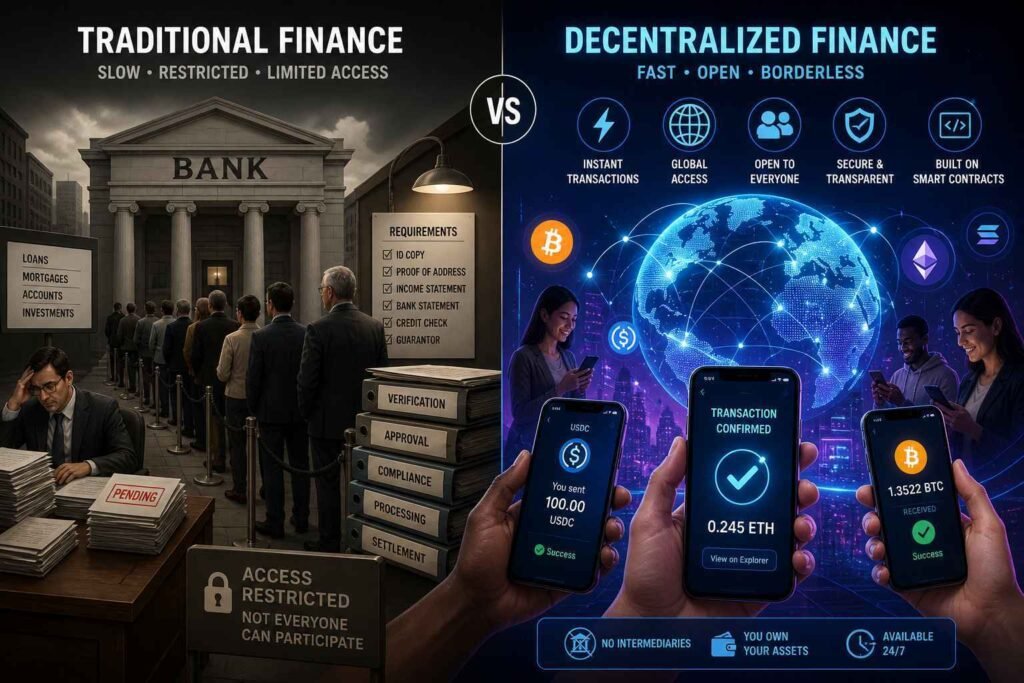
Account fees, transaction delays, geographic restrictions and exclusion of the unbanked are not accidents of the system. They are features of a model built around institutional control. DeFi does not improve on that model. It replaces the underlying assumption entirely.
Where a bank loan requires identity verification, credit history and approval from a human underwriter, a DeFi lending protocol requires collateral and a crypto wallet. Where a stock exchange operates for eight hours on business days, a decentralized exchange runs every hour of every day without interruption.
The tradeoff is real though. Traditional finance offers consumer protections, regulatory oversight and recourse when things go wrong. DeFi offers none of those things. A smart contract exploit, a rug pull or a market collapse can wipe out funds with no authority to appeal to and no insurance to fall back on.
Risks of DeFi Investing
DeFi’s openness is also its biggest vulnerability. Any protocol can be deployed by anyone, and not all of them are built with user protection in mind.
Smart contract exploits are among the most common and costly risks in the space. Code vulnerabilities that go undetected during audits can be discovered and exploited by bad actors, draining liquidity pools within minutes. Billions of dollars have been lost to smart contract bugs across various protocols since DeFi’s early days.
Rug pulls represent a different category of risk. A development team launches a protocol, attracts liquidity from investors and then disappears with the funds. The anonymous nature of DeFi makes accountability nearly impossible in these situations. Due diligence on the team behind any protocol matters as much as the technology itself.
Liquidation risk catches many DeFi borrowers off guard. Collateralized loans require maintaining a minimum collateral ratio. A sharp price drop in the deposited asset can trigger automatic liquidation before a borrower has time to respond, resulting in significant losses even if the broader market recovers shortly after.
Regulatory uncertainty adds another layer. Governments worldwide are still determining how DeFi protocols fit within existing financial regulations. Protocols that operate freely today could face restrictions tomorrow depending on how regulatory frameworks evolve.
Getting Started With DeFi Research
Entering DeFi without a solid foundation in how the underlying protocols work is one of the faster ways to lose capital in crypto. The space moves quickly, terminology is dense and the difference between a legitimate protocol and a poorly built one is not always obvious from the surface.
Starting with the basics matters more than it might seem. Understanding how smart contracts function, how liquidity pools are structured and how collateralization works in lending protocols gives investors a framework for evaluating any new project they encounter. That foundation does not take long to build but it changes how the entire space looks.
Tracking protocol audits, team transparency and on chain data are research habits that separate informed DeFi participants from those relying purely on community sentiment and social media. Independent research across multiple sources builds a more complete picture than any single guide can provide.
For those building that foundation, DeFi and blockchain guides covering these fundamentals are a practical starting point before committing capital to any protocol.
Conclusion
DeFi has introduced a genuinely different model for how financial services can operate. Whether that model becomes mainstream infrastructure or stays a niche corner of crypto depends on how technology, regulation and market behavior develop together over the next few years.
The protocols are complex, the risks are real and the space changes fast. Approaching it with solid research habits from the start is not a cautious move. It is just the sensible one.
