
NFTs spent two years dominating headlines, generating billions in sales and confusing nearly everyone who did not already spend time in crypto circles. Then the market collapsed, the coverage disappeared and most people assumed the story was over.
It was not.
Table of Contents
How NFTs Actually Work
Every NFT is a unique token recorded on a blockchain. Unlike cryptocurrencies where each unit is identical and interchangeable, no two NFTs share the same value or identity. Owning one Bitcoin is the same as owning any other Bitcoin. Owning a specific NFT means owning something that exists exactly once on the blockchain.
The technical standard that makes this possible on Ethereum is ERC-721. This protocol defines how unique tokens are created, owned and transferred on the network. Each token contains metadata pointing to the associated digital asset, whether that is an image, audio file, video or any other format stored on or off chain.
Smart contracts handle the entire ownership process. When an NFT is minted, a smart contract records the creator, the token ID and the ownership address permanently on the blockchain. Every subsequent transfer updates that record automatically without any intermediary involved in the transaction.
What the blockchain records is proof of ownership, not the asset itself. The image or file an NFT represents is typically stored separately. This distinction matters more than most NFT buyers realize at the time of purchase.
What Makes an NFT Valuable
Scarcity drives most of the conversation around NFT value, but scarcity alone explains very little. Anyone can mint a million unique tokens. The question is whether anyone wants them.
Provenance, utility and community weight are what actually separate NFTs that hold value from those that do not. A token created by a recognized artist, attached to a project with real development activity or connected to a brand with cultural credibility operates under completely different market dynamics than an anonymous mint with nothing behind it. Utility has become especially important as the speculative wave receded. NFTs granting access to communities, events or real world benefits hold value beyond the asset itself.
Liquidity is the dimension most buyers overlook until they try to sell. An NFT is worth exactly what someone will pay for it at that specific moment. Thin markets mean theoretical valuations and actual exit prices rarely match.
Types of NFTs
Digital art was the category that put NFTs on the map. Artists began minting original works directly on blockchain platforms, selling to collectors without galleries or auction houses involved.
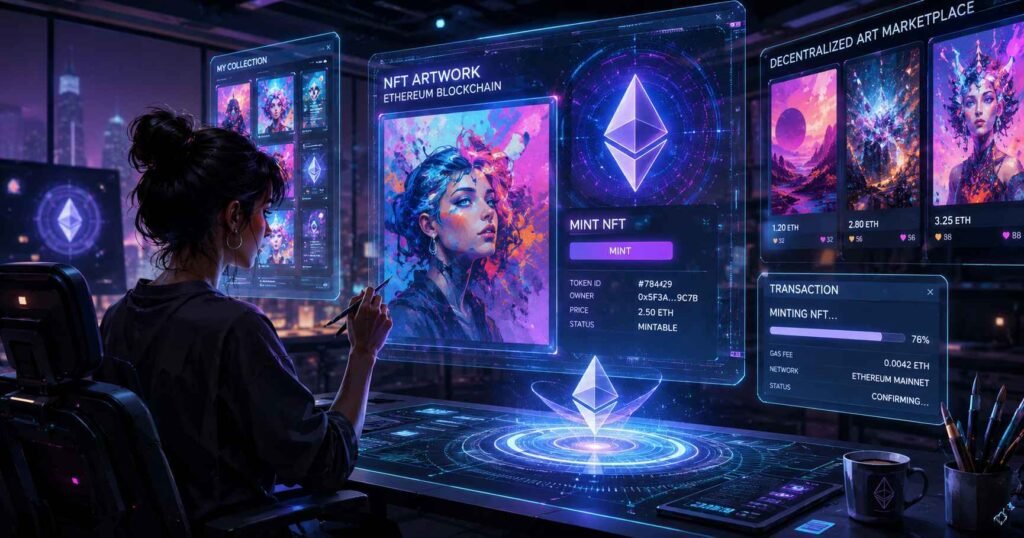
Beeple’s $69 million sale in 2021 was the moment mainstream media took notice, though the market had been building quietly for years before that single transaction changed the conversation entirely.
Music NFTs followed a similar logic, with artists minting albums, singles and exclusive recordings directly to fans and bypassing streaming platforms that pay fractions of a cent per play. Some music NFTs include royalty rights, backstage access or simply a verifiable connection between fan and artist that streaming services cannot replicate.
Gaming has arguably produced the most practical NFT use case so far. In game items, characters and land parcels minted as NFTs give players genuine ownership of digital assets that exist and trade independently of the game environment itself.
Beyond entertainment, NFTs are being explored for property deeds, academic credentials and legal contracts. These applications are still early but they represent a version of the technology that has nothing to do with digital art and everything to do with how ownership gets recorded.
NFTs and Cryptocurrency
NFTs and cryptocurrency share the same underlying infrastructure but serve fundamentally different purposes. Cryptocurrency functions as a medium of exchange where each unit holds identical value. NFTs are designed specifically to be non-interchangeable, with each token representing something unique.
Ethereum remains the dominant blockchain for NFT activity, largely because its smart contract capabilities and ERC-721 standard gave developers the tools to build NFT marketplaces and minting platforms before any competing network reached comparable scale. Other blockchains including Solana and Polygon have since developed active NFT ecosystems with lower transaction fees.
Buying and selling NFTs requires cryptocurrency. Most transactions on Ethereum based platforms are conducted in ETH, while Solana based marketplaces use SOL. This connection means NFT market activity is closely tied to broader crypto market conditions. When crypto prices fall sharply, NFT liquidity tends to contract alongside them.
For investors researching digital assets across both categories, cryptocurrency and NFT guides covering these connections provide useful context before entering either market.
The Risks of Buying NFTs
Market volatility in NFTs moves faster and more severely than in most other digital asset categories. Floor prices on even established collections can drop 80 to 90 percent within weeks during broader market downturns.
Scams are widespread and come in multiple forms. Fake collections mimicking established projects, phishing links disguised as minting opportunities and wash trading used to artificially inflate perceived demand are common enough that new buyers encounter them almost immediately. Verifying the official contract address before connecting a wallet is a basic precaution that many skip entirely, often with costly results.
Illiquidity is a structural reality rather than a temporary condition. An NFT sale depends on finding one willing buyer at that specific moment.
Storage risk rounds out the picture. NFTs point to files stored somewhere external to the blockchain, and if that storage solution fails or shuts down, the underlying asset can disappear while the token remains intact.
Where NFTs Are Headed
The speculative phase of NFTs is largely over. What remains is a smaller, more focused ecosystem working through what the technology actually does well rather than what it can be sold for.
Real world asset tokenization is the direction attracting the most serious development attention. Property ownership, legal agreements, financial instruments and supply chain documentation are all areas where NFT infrastructure offers a more transparent and tamper resistant alternative to existing record keeping systems. These applications do not generate the same headlines as a $69 million jpeg but they represent a more durable use case.
Digital identity is another area with genuine long term potential. Credentials, certifications and membership records stored as NFTs give individuals portable, verifiable proof of their qualifications and affiliations without relying on centralized databases that can be hacked, altered or simply taken offline.
Gaming will likely remain one of the strongest near term use cases. True ownership of in game assets that persist across platforms and can be traded outside any single game environment solves a real problem for a large and engaged user base.
Whether NFTs become foundational infrastructure or remain a niche application depends less on the technology itself and more on whether developers build things people actually need.
Conclusion
NFTs are not dead and they were never just about overpriced digital art. The technology solves a real problem around digital ownership and provenance that existed long before the 2021 boom and will remain relevant long after the speculation has fully cleared.
The use cases that matter are still being built. That is not a weakness of the technology. It is just where things stand.
